Cart
0
You may also like


Every Gujarati kitchen knows saragva. The long drumsticks go into kadhi and sambar, and in many homes someone still strips the small leaves off the branch on a Sunday morning for a quick sabzi or a batch of thepla. Nobody at that table called it a superfood. It was just food.
Then the same leaf came back to us as a green powder in a pouch, with a label promising to "detox your body" and "flush out toxins". So the question we get asked most about moringa is a fair one: does it actually detox you, or is that just marketing?
Short answer: your liver and kidneys do the detox work, every day. What moringa leaf brings is nutrition and antioxidant plant compounds that are part of a diet that looks after them. That is the real reason moringa has been on Indian plates for generations.
"Detox" in a supplement ad usually means something vague: toxins leave, you feel lighter, your skin glows. No food or herb works like a filter that pulls toxins out, and we would rather tell you that plainly.
Your body already has a detox system. The liver breaks down alcohol, medicines and waste products from normal metabolism. The kidneys filter the blood and send what is not needed out in urine. The gut moves the rest along. None of these organs is waiting for a powder to switch it on.
What food can do is support the organs that do this work: enough water, enough fibre, enough protein, enough vitamins and minerals, and not too much alcohol or ultra-processed food. Moringa leaf fits into that picture as a nutritious green.
If someone tells you that you will "feel the toxins leaving" in a week, be careful. If you feel lighter after adding greens and cutting fried snacks, that is good eating doing its job.
This part is real and well documented. According to USDA nutrient data for raw drumstick leaves (FoodData Central, FDC ID 168416), 100 g of fresh leaves contain roughly:
Two honest caveats. First, you will not eat 100 g of fresh leaves in a day very often; a typical katori of saragva sabzi is less. Second, iron from plants is absorbed less well than iron from meat or eggs. Eating it with something sour, like lemon or amla, helps, because vitamin C improves plant iron absorption.
The leaves also carry plant compounds called polyphenols, such as quercetin and chlorogenic acid. In lab and animal studies, these act as antioxidants. A 2015 review in Phytotherapy Research found that leaf extracts showed the strongest antioxidant activity of any part of the plant (Stohs and Hartman, 2015).
Moringa has been studied a lot in the lab, and human research is growing. Here is what it looks like.
The 2015 review above looked at the human studies available at the time, all using powdered whole leaf, and none reported side effects. Much of the wider research is in lab and animal studies, which is why we talk about moringa as nutrition, not as a remedy.
One of the better human studies happens to be Indian. At Punjab Agricultural University in Ludhiana, researchers added drumstick leaf powder to the daily food of 30 postmenopausal women aged 45 to 60 for three months, and compared them with 30 women who got nothing extra (Kushwaha, Chawla and Kochhar, Journal of Food Science and Technology, 2014; a third group of 30 got amaranth leaf powder). The moringa group showed higher blood levels of vitamin C and retinol, better antioxidant enzyme readings, a lower marker of oxidative stress, and higher haemoglobin.
It was a small study at one university, so it is a promising sign rather than the final word. It also shows what three months of daily moringa as part of normal Indian food can look like, which is how we think about it too: a steady daily habit, not a quick fix. Claims that moringa cleans your blood or fixes a medical condition go beyond what has been shown, and we do not make them.
This is the "detox" question people search most, so it deserves a straight answer. Most of the research on moringa and the liver so far is in lab and animal studies, where leaf extracts showed antioxidant activity in liver tissue. Human research on this is still early, so we do not claim moringa improves liver health.
If you have a liver condition, raised liver enzymes on a report, or you drink regularly, the first step is a doctor and a proper test, not a supplement. Our Indian fatty liver diet guide covers the food changes that have much stronger evidence behind them.
The cheapest moringa is still on the tree. If there is a saragva tree in your society or your village, you already have the best version.
Buying powder? Turn the pack around. It should say leaf, not root or bark. It should list an FSSAI licence number and a manufacturer address. It should be green, not brownish, and smell fresh. Store it in an airtight jar away from sunlight.
Powder is closer to the food. You get the fibre and the minerals, but you have to like the taste and you have to remember to use it.
Capsules suit people who will not drink a grassy glass of water every morning. They are usually either plain leaf powder or a concentrated extract. An 8:1 extract is made by concentrating about eight times its weight in leaf, so a small capsule carries the plant compounds of a much larger amount of leaf. Fresh leaves on your plate still give you the fibre, so the best routine is both: greens when you can, a capsule for the days you cannot.
Moringa leaf has been eaten as food in India for generations and is considered likely safe for most people. In studies, leaf supplements have been used with apparent safety for up to about 90 days. As with any supplement, a few groups should check with a doctor first. Based on the Natural Medicines summary published on RxList:
Start with a small amount and take it with food.
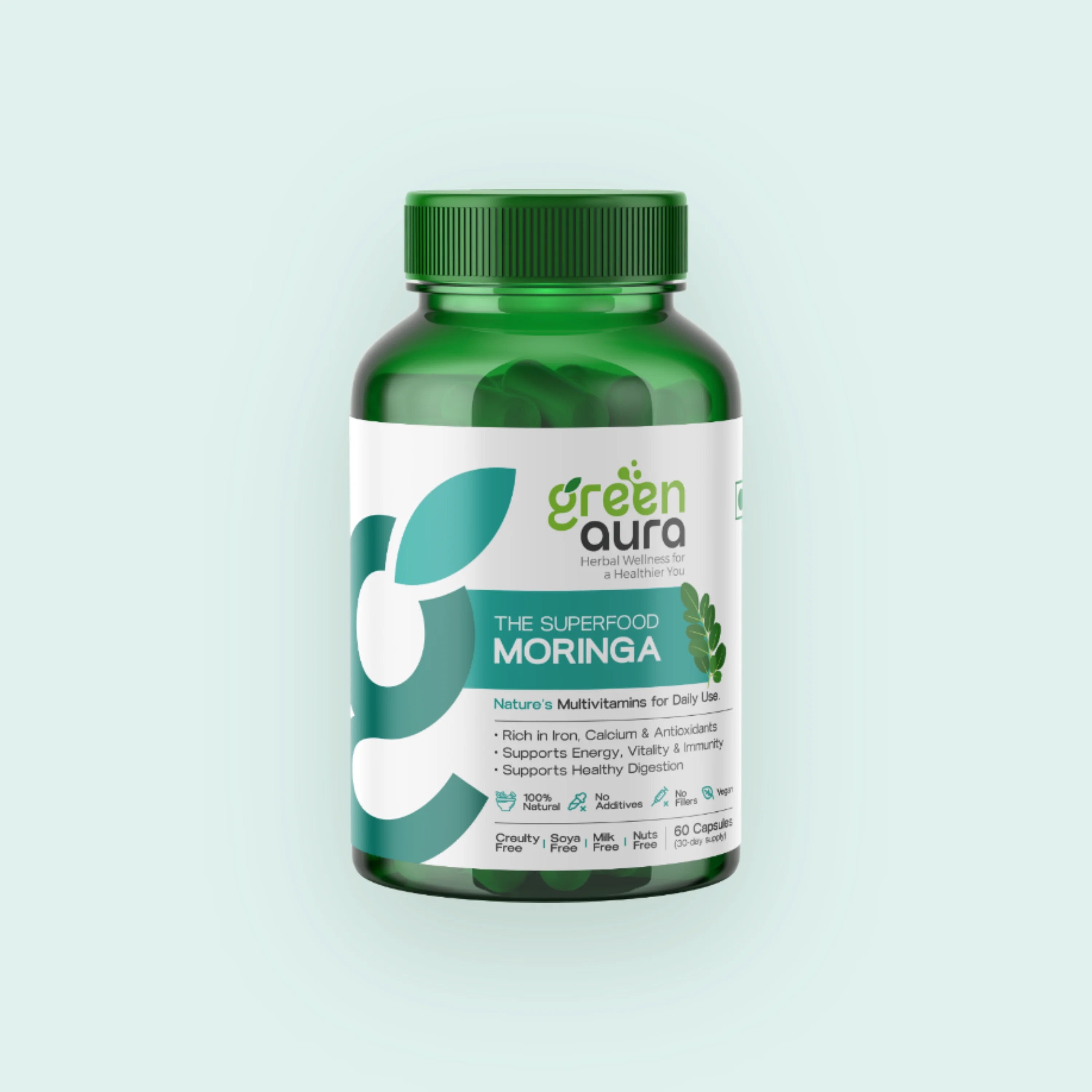
We make Green Aura Moringa at our own FSSAI licensed unit in Vijapur, Gujarat. Each capsule has 500 mg of 8:1 moringa leaf extract, leaf only, never root or bark, with the milligrams printed on the label and no proprietary blend. Two capsules a day, one after breakfast and one after dinner, give you 1,000 mg of extract, concentrated from roughly eight times that amount of leaf.
It is a daily herbal food supplement for people who want moringa in their routine without the grassy taste or the measuring spoons. Take it alongside a balanced diet, and keep the caution list above in mind. If you are not sure whether any of our formulas suits you, you can Take the Test.
Moringa leaf is a properly nutritious green with real antioxidant compounds, and our grandmothers were right to cook it. Skip the "flush out toxins" promises and value it for what it is: steady daily nutrition. Eat the leaves when you can, choose a leaf-only product with the milligrams on the label when you cannot, and talk to your doctor first if you are pregnant or on thyroid, sugar or BP medicines.
Related reading: Turmeric and black pepper: why they go together.
Quick answers
No food flushes toxins out of you; your liver and kidneys do that. Moringa leaf is a nutritious green with protein, vitamin C, calcium, iron and antioxidant plant compounds. It can be part of a diet that supports those organs, but there is no good human evidence that it detoxes the body.
Most liver research on moringa so far is in lab and animal studies, and human research is still early, so we do not claim it improves liver health. If you have a liver condition or raised liver enzymes, see a doctor first.
Blood cleansing is a traditional idea, not a medical one. Your kidneys filter your blood. Moringa does supply antioxidants and nutrients such as iron and vitamin C, but it does not filter or clean the blood.
As food, a handful of fresh leaves or half to one teaspoon of leaf powder is a sensible start. For capsules, follow the label: for Green Aura Moringa that is 2 capsules a day after meals, which is 1,000 mg of 8:1 leaf extract.
Moringa leaf as food is considered likely safe for most people, and in studies leaf supplements have been used with apparent safety for up to about 90 days. Avoid the root and bark. Ask your doctor first if you are pregnant or breastfeeding, or if you take thyroid, blood sugar or blood pressure medicines, as moringa may interact with them.
Powder and fresh leaves give you fibre along with the nutrients. Capsules are easier if you dislike the taste, and a concentrated extract carries the plant compounds of a larger amount of leaf in a small dose. Many people use both: greens when they can, capsules for busy days.
This information is for general awareness. Green Aura products are food supplements, not medicines, and are not intended to diagnose, treat, cure or prevent any disease.
Where to start
Green Aura Moringa. Every milligram declared.
An 8:1 leaf extract, 500 mg per capsule, leaf only, in a plant based shell. Most people prefer a 3 month supply so they are not reordering every month.
| 3 month course180 capsules | ₹1,029 | Add to cart |
| 1 month60 capsules | ₹410 | Add to cart |
| 6 month course360 capsules | ₹1,799 | Add to cart |
Our 30 day promise. Start the course. If the first month is not for you, tell us within 30 days and we will collect the bottles you have not opened, at our cost, and refund them in full. It applies to the 3 and 6 month courses, so the longer the course, the less you risk.
Free delivery on every order. Cash on Delivery available. Made at our own FSSAI licensed unit in Vijapur, Gujarat, Central Licence 10725997000306.
Sources: Stohs SJ, Hartman MJ. Review of the Safety and Efficacy of Moringa oleifera. Phytotherapy Research, 2015;29(6):796 to 804; Kushwaha S, Chawla P, Kochhar A. Effect of supplementation of drumstick (Moringa oleifera) and amaranth (Amaranthus tricolor) leaves powder on antioxidant profile and oxidative status among postmenopausal women. J Food Sci Technol. 2014;51(11):3464 to 3469; RxList, Moringa: uses, side effects and interactions; USDA FoodData Central, Drumstick leaves, raw (FDC ID 168416).
This article is for general information only and is not medical advice. Green Aura products are food supplements and are not intended to diagnose, treat, cure or prevent any disease. Please consult your doctor before starting any supplement, especially if you are pregnant, nursing, on medication or have a medical condition.


