Cart
0
You may also like


Ask your nani about Shatavari and she will probably tell you it is "for women". She may remember it stirred into warm milk after a delivery, or a bottle of Shatavari kalpa on the kitchen shelf. Ask the internet, and you will be told it fixes hormones, fertility, PCOS, menopause, breast milk and stress, all at once.
Both can't be fully right. So here is what Shatavari is, how Ayurveda has used it, what the modern research actually shows, and who should be careful with it.
Quick answer: Shatavari (Asparagus racemosus) is one of the best known herbs in Ayurveda for women's general wellness, traditionally used as a rasayana (rejuvenating herb). Modern human research is small but growing. The strongest recent trial, in 2025, found that 300 mg a day of a Shatavari root extract eased menopause symptoms over 8 weeks compared with placebo. Evidence for breast milk, fertility and PCOS is weak or very limited. It is generally well tolerated, but some women should check with a doctor first.
Shatavari is a climbing plant of the asparagus family that grows across India, from the Himalayan foothills to the south. The part used is the root, a bunch of pale, finger-like tubers. Its Sanskrit name is often read as "she who has a hundred roots", a nod both to the root's shape and to its long reputation as a women's herb.
In Ayurveda, Shatavari is described as a rasayana, a herb taken over time for general strength and vitality, and as cooling and nourishing in nature. It is one of the herbs most often linked with women's health across the different stages of life, from the monthly cycle to new motherhood to the years around menopause.
You will find it as powder (churna), as granules mixed with milk (Shatavari kalpa or Shatavari granules), as ghee preparations, and as capsules of root extract.
This is where most articles get carried away. Laboratory research on Shatavari is extensive, and human research is growing. Here is what the human evidence looks like, area by area.
In 2025, a randomised, double-blind trial published in Frontiers in Reproductive Health tested a Shatavari root extract in 135 women aged 45 to 65, at sites in Navi Mumbai and the United States. Women took 300 mg of the extract a day, 300 mg plus Ashwagandha, or a placebo, for 8 weeks.
The authors list honest limits: a small trial, only 8 weeks long, in women from a few places, with one specific branded extract. It is an encouraging result, not proof that every Shatavari product will do the same.
Shatavari is among the most widely used traditional herbs in India for new mothers. A Cochrane review in 2020, which looked at many "milk boosters" including Shatavari, concluded that for natural galactagogues as a group, "we are very uncertain about the magnitude of the effect", with low to very low certainty evidence. In plain words: we do not yet have good trials showing it raises milk supply.
If you are breastfeeding and worried about supply, a lactation consultant or your doctor is the right first step. Feeding often and a good latch make more difference than any herb.
You will see many claims that Shatavari "balances hormones" or helps with PCOS and fertility. Research in these areas is still at an early, laboratory stage, and there are no strong human trials showing that Shatavari treats PCOS or improves fertility. If you have PCOS or are trying to conceive, please work with a gynaecologist. Our guide to PCOD vs PCOS explains how the condition is diagnosed and what the research supports.
Ayurveda groups Shatavari with other rasayana herbs used for vitality. In the 2025 menopause trial, Shatavari alone did not clearly lower stress scores compared with placebo. So, for now, think of it as a traditional women's herb with one promising modern trial, not as a stress remedy.
Raw powder and an extract are not the same thing. A 4:1 extract, for example, is made from roughly four parts of root for every one part of extract. When you compare products, look at both the milligrams and the extract ratio on the label. If a label does not tell you either, that is worth noticing.
Shatavari has a long history of food-like use in India and was well tolerated in the recent trial. But please speak to your doctor before taking it if any of these apply to you:
Stop and see a doctor if you notice a rash, swelling, breathing trouble or any unusual symptom after starting it.
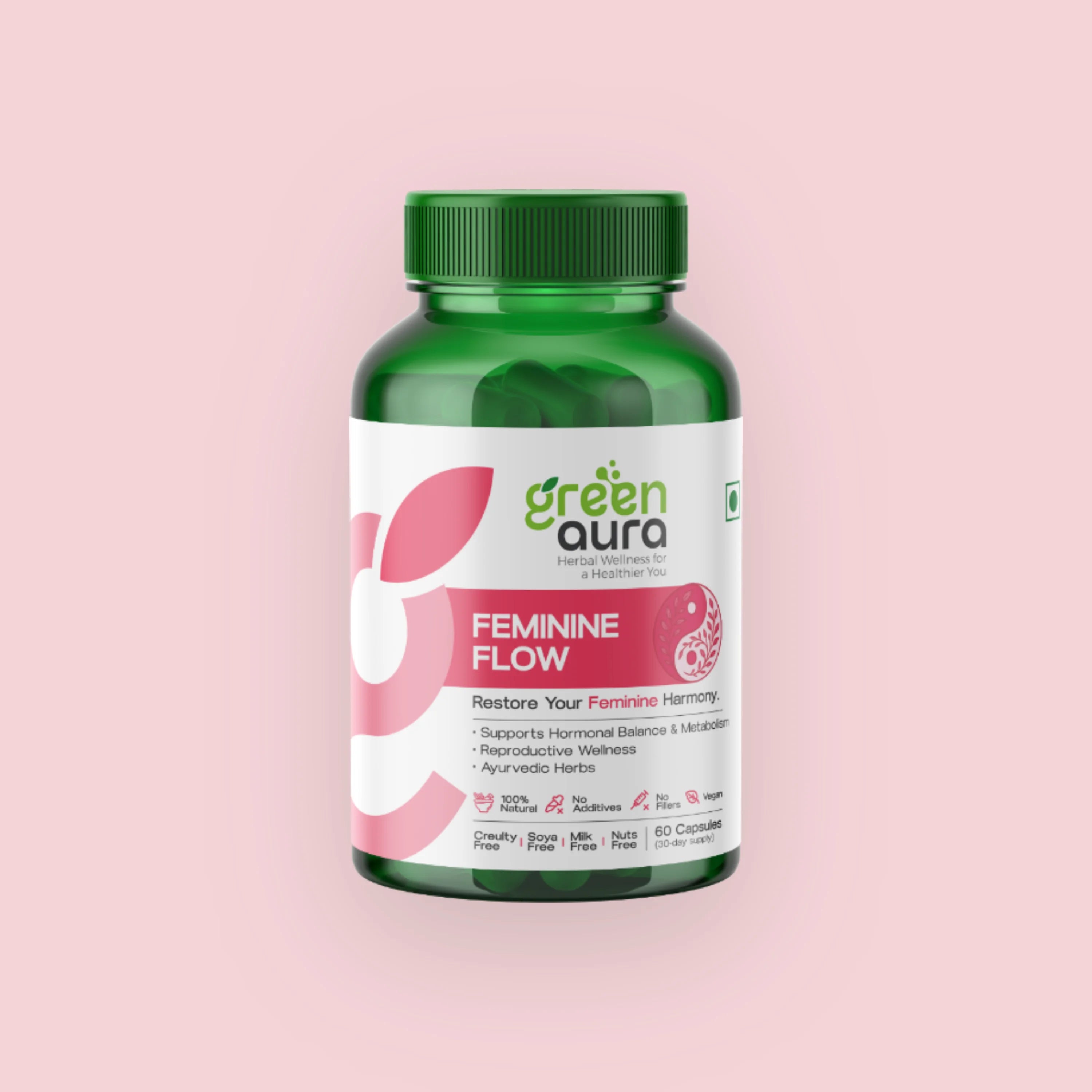
We make Feminine Flow at our own FSSAI licensed unit in Vijapur, Gujarat. It is a daily women's wellness food supplement with eight Ayurvedic herbs, and Shatavari leads the formula: each capsule has 111.1 mg of a 4:1 Shatavari root extract, alongside Daruharidra, Lodhra and five more herbs, every milligram printed on the label.
The 2025 trial used a specific branded extract, so its results belong to that extract. Feminine Flow is a daily herbal routine for women's general wellness, taken as 2 capsules a day after meals.
Not sure which of our formulas suits you? Take the Test. It takes about two minutes.
For women's daily wellness
Feminine Flow, 60 capsules, Rs 899
In Ayurveda, Shatavari is a traditional rasayana herb for women's general wellness across life stages. In modern research, the best human evidence so far is a 2025 trial in which a Shatavari root extract eased menopause symptoms over 8 weeks compared with placebo. Evidence for other uses is limited.
There are no strong human trials showing that Shatavari treats PCOS. Research in this area is still at an early stage. If you have PCOS, please work with a gynaecologist.
Many people take it daily as part of a routine, and the 2025 trial used it daily for 8 weeks without serious side effects. Long-term safety studies are limited. Check with your doctor if you are pregnant, breastfeeding, on regular medicine or have a hormone-sensitive condition.
It is widely used for this in India, but a 2020 Cochrane review found the evidence for herbal milk boosters very uncertain. Speak to a lactation consultant or doctor if you are worried about supply.
Ayurveda mein Shatavari ko mahilaon ki samanya sehat ke liye rasayana jadi-booti mana jata hai. Aadhunik research mein sabse acchha saboot 2025 ki ek trial hai, jismein Shatavari root extract se 8 hafton mein menopause ke lakshan placebo se behtar hue. Baaki upyogon ke liye saboot abhi kam hai. Pregnancy, dawai ya hormone se judi bimari ho to pehle doctor se poochhiye.
Shatavari is a much-loved traditional herb for women, and one good modern trial now supports its use for menopause symptoms. For breast milk, fertility, hormones and PCOS, the evidence is not there yet, whatever the internet says. If you take it, choose a product that tells you exactly how much is inside, give it time, and talk to your doctor if you are pregnant, on medicine or have a hormone-sensitive condition.
About the author
Aditya Patel is the founder of Green Aura, which makes its herbal food supplements in-house at its FSSAI licensed unit in Vijapur, Mahesana, Gujarat. He is not a doctor. This article is based on the published research linked above.
This article is for general information only and is not medical advice. Green Aura products are food supplements and are not intended to diagnose, treat, cure or prevent any disease. Please consult your doctor before starting any supplement, especially if you are pregnant, nursing, on medication or have a medical condition.


