Cart
0
You may also like


The ultrasound report says "bulky ovaries with multiple follicles". The doctor says "PCOD". Your cousin says she has "PCOS". A reel on Instagram says one is a disease and the other is "just a disorder". By the end of the evening you have read ten articles and you are more confused than when you started.
You are not alone. PCOD and PCOS are two of the most searched women's health terms in India, and the internet explains them in ten different ways. This guide sorts out what the two words actually mean, how the condition is diagnosed, the new name doctors have just agreed on, and the everyday changes that the research supports.
Quick answer: PCOS (polycystic ovary syndrome) is the medical name used in international guidelines. PCOD (polycystic ovarian disease) is an older term still common in India, and most Indian doctors use it for the same condition or a milder picture of it. There is no separate international definition of "PCOD". In May 2026, an international group of experts renamed PCOS as PMOS, polyendocrine metabolic ovarian syndrome, because the condition is about hormones and metabolism, not cysts. Diagnosis and care have not changed.
Many Indian websites say PCOD is a mild "disorder" of the ovaries and PCOS is a serious "syndrome" of the hormones. That split is common, and some doctors do use the words this way. But it is not how the condition is defined internationally.
The international guideline that doctors around the world follow, last updated in 2023, describes one condition: polycystic ovary syndrome. It does not recognise "PCOD" as a separate diagnosis. In practice, when an Indian gynaecologist says PCOD, she may mean:
That second meaning matters, because polycystic-looking ovaries on a scan are not a diagnosis on their own. Many women with perfectly regular cycles have ovaries that look like this, especially in their teens and twenties. If your report uses the word PCOD, the useful question to ask your doctor is simple: "Do I meet the criteria for PCOS, or is this only an ultrasound finding?"
PCOS is a common hormonal condition in women of reproductive age. It affects how the ovaries release eggs, and it often comes with higher levels of male-type hormones (androgens) and with insulin resistance, where the body needs more insulin than usual to keep blood sugar in check.
The name has always been misleading. The "cysts" seen on the scan are not true cysts. They are small follicles, eggs that started to develop and then stopped. And the name says nothing about the parts of the condition that matter most over a lifetime: blood sugar, weight, heart health, skin and mood.
So in May 2026, after a global process led by Monash University in Australia and the University of Pennsylvania, with 56 academic, clinical and patient organisations and more than 14,000 survey responses, the condition was renamed polyendocrine metabolic ovarian syndrome (PMOS) in a paper published in The Lancet. One of the leaders put it plainly: "There are no cysts in the ovaries."
Two things to know about the change:
Very common. A 2022 review that pooled 11 Indian studies, with more than 6,500 women, found that about 11 in every 100 women met the Rotterdam criteria for PCOS, the criteria most doctors use. Using stricter criteria, the figure was closer to 6 in 100. The authors pointed out that the number changes a lot depending on which definition a study uses, which is one reason the figures you read online vary so much.
Experts behind the new name estimate that up to 70% of people with the condition worldwide have never been diagnosed. Many women live with irregular periods, acne or weight changes for years without anyone connecting the dots.
PCOS looks different from one woman to the next. Common signs include:
Not every woman with PCOS is overweight, and not every overweight woman with irregular periods has PCOS. That is why it needs a proper check, not a guess from a list.
For adults, the 2023 international guideline asks for at least two of these three:
Your doctor will also rule out other causes that can look similar, such as thyroid problems or a raised prolactin hormone. That is why the usual workup includes a few blood tests along with the scan.
A few points that save a lot of worry:
This is the part the new name was designed to fix. The international guideline highlights that women with PCOS have a higher risk of early high blood sugar and type 2 diabetes, and a higher risk of heart and blood vessel problems. Depression and anxiety are also more common.
None of this is a reason to panic. It is a reason for regular, simple checks: blood sugar, blood pressure, cholesterol and weight, and an honest conversation about mood. In India, where diabetes is already very common, a woman with PCOS should treat her yearly blood sugar test as non-negotiable.
A 2024 review in the Annals of Internal Medicine pooled 26 trials with more than 1,500 women with PCOS. Women in weight loss programmes lost on average about 4 kg more than those in usual care, and they had about two to three more periods a year, along with lower insulin resistance and lower androgen levels. You do not need a dramatic transformation for the body to respond.
If you are not overweight, the goal is simply to avoid gradual weight gain, which the guideline recommends for every woman with PCOS.
The international guideline is clear: for diet and exercise, "there is no one superior approach". Ignore anyone who says you must give up dairy, gluten or fruit forever. What matters is a pattern you can keep up. For most Indian homes that means:
A brisk walk after dinner, yoga, cycling, dance, or a game of badminton all count. The World Health Organization advises adults to get at least 150 minutes of moderate activity a week, plus muscle-strengthening on two or more days. Squats, lunges and resistance bands at home are enough. Muscle uses blood sugar, which is exactly what insulin resistance needs.
Short sleep and constant stress make blood sugar and appetite harder to manage. A fixed sleep and wake time is one of the most underrated habits for PCOS.
Depending on your goals, a doctor may suggest the contraceptive pill to regulate cycles and reduce androgen symptoms, metformin (which the guideline suggests considering in adults with a BMI of 25 or more), or fertility treatment if you are trying to conceive. These are decisions to make with your gynaecologist or endocrinologist, not with a reel.
Be careful here. PCOS is one of the most heavily marketed conditions in India, and many products promise to "cure PCOD" or "dissolve cysts". No food supplement can do that, and under Indian food law, no supplement is allowed to claim it.
The international guideline looked at inositol, the most researched PCOS supplement, and concluded it "may be considered" based on personal preference, with limited harm but limited evidence of benefit for ovulation, excess hair or weight. Your doctor will also advise folic acid if you are planning a pregnancy.
If you take any supplement, tell your doctor, especially if you are on the pill, metformin, thyroid medicine or fertility treatment.
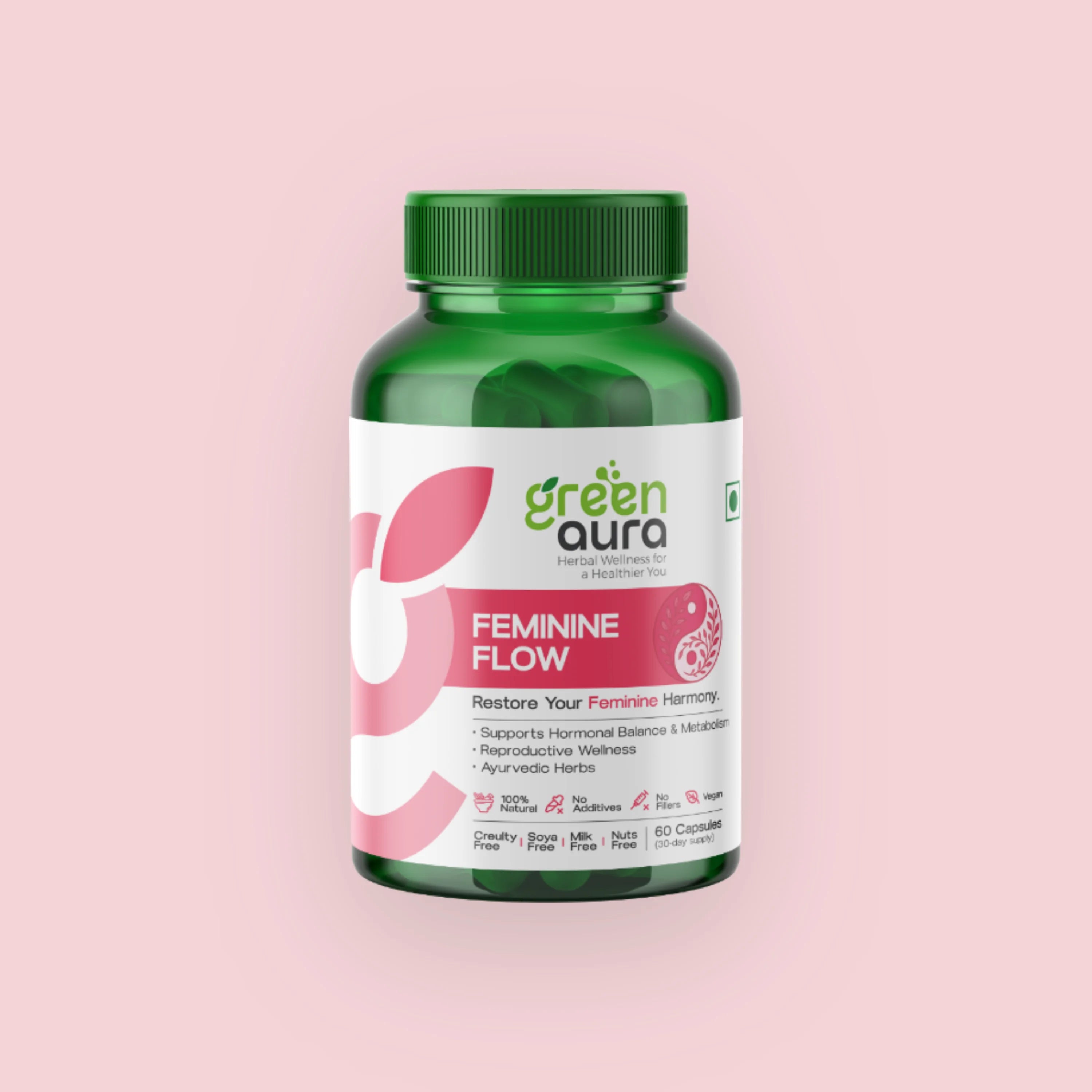
We make Feminine Flow at our own FSSAI licensed unit in Vijapur, Gujarat. It is a daily women's wellness food supplement made with eight Ayurvedic herbs, led by Shatavari, Daruharidra and Lodhra, with every milligram printed on the label and no proprietary blend.
To be straight with you: Feminine Flow is not a treatment for PCOS, PCOD or PMOS, and it is not a replacement for anything your doctor recommends. If you have been diagnosed with PCOS, or you take the pill, metformin, thyroid medicine or any regular medicine, please speak to your doctor before starting it.
Not sure which of our formulas suits your routine? Take the Test. It takes about two minutes.
Take a simple record with you: the start date of your last six periods, any symptoms, and your weight. It makes the first appointment much more useful. If period pain is part of your picture, our guide to period cramps relief at home covers what helps and when to worry.
For women's daily wellness
Feminine Flow, 60 capsules, Rs 899
In international medical guidelines there is only one condition, PCOS, now also called PMOS. PCOD is an older term still used in India, either for the same condition or for polycystic-looking ovaries on a scan without the other signs. Ask your doctor which one your report means.
PMOS stands for polyendocrine metabolic ovarian syndrome. It is the new name for PCOS, agreed by an international expert group and published in The Lancet in May 2026, because the condition involves hormones and metabolism, not true cysts. The diagnosis and treatment have not changed.
PCOS is a long-term condition that cannot be cured, but its symptoms can usually be managed well. Weight management where needed, regular activity, a balanced diet and medical treatment when required help many women have regular cycles and healthy pregnancies.
Yes. Many women with PCOS conceive naturally, and others with help from treatment. If you have been trying for a year, or six months if you are over 35, see a gynaecologist.
No. Polycystic-looking ovaries are common in women without PCOS, especially younger women. Adults need at least two of three features: irregular ovulation, signs of high androgens, and polycystic ovaries on a scan or a raised AMH level.
Antarrashtriya medical guidelines mein ek hi condition hai, PCOS, jise ab PMOS bhi kaha jata hai. PCOD purana shabd hai jo Bharat mein aksar isi condition ke liye, ya sirf ultrasound mein dikhe polycystic ovaries ke liye use hota hai. Sirf scan se PCOS diagnose nahi hota. Apne doctor se poochhiye ki aapki report ka matlab kya hai.
PCOD and PCOS are two names for one condition in the eyes of international medicine, and it now has a better name: PMOS. It is diagnosed with at least two of three signs, never by a scan alone. It is about hormones and metabolism, so regular blood sugar checks matter as much as regular periods. Modest weight loss if you need it, steady movement, a balanced Indian plate and a good doctor do most of the work. Be wary of anyone selling a cure.
About the author
Aditya Patel is the founder of Green Aura, which makes its herbal food supplements in-house at its FSSAI licensed unit in Vijapur, Mahesana, Gujarat. He is not a doctor. This article is based on the international PCOS guideline and the published research linked above.
This article is for general information only and is not medical advice. Green Aura products are food supplements and are not intended to diagnose, treat, cure or prevent any disease. Please consult your doctor before starting any supplement, especially if you are pregnant, nursing, on medication or have a medical condition.


