Cart
0
You may also like


By Aditya Patel, Founder, Green Aura (manufacturer, Vijapur, Gujarat)
The report comes back from a routine health check-up, the kind your office or your family insists on every year. Most numbers are fine. Then, at the bottom of the ultrasound page, one line: "Fatty liver, Grade 1."
No pain. No warning. You eat ghar ka khana, you do not drink much, and you are not even that overweight. So what now?
You are in very large company. A 2026 study of 7,764 adults across 27 Indian cities found that about four in ten had fatty liver (now called MASLD, metabolic dysfunction-associated steatotic liver disease). Many people find out only from a routine scan, like you just did.
Food and movement are the main tools doctors use for this condition, yet most diet lists online just say "eat whole grains, avoid junk food", which nobody can act on. This Indian fatty liver diet guide is built around our own plate: the chai, the rotis, the rice, the festivals and the late dinners.
Fatty liver means fat makes up more than about 5% of the liver. An ultrasound usually notices it once there is a fair bit more than that. "Grade 1, 2 or 3" describes how bright the liver looks on the scan, roughly how much fat is visible. It does not tell you whether there is inflammation or scarring underneath.
That second question matters more. In the same Indian study, about 6.3% of people with fatty liver already had significant scarring (fibrosis) on a liver stiffness scan (FibroScan), compared with 1.7% of people without fatty liver. Scarring was more common in people over 60, people with diabetes and people with higher degrees of obesity.
So before changing your diet, ask your doctor one question: "Do I need a FibroScan or a fibrosis score (like FIB-4) from my blood tests?" It is a quick way to learn whether your liver is simply storing fat or is starting to scar.
Yes, and this is the doubt we hear most often. The Phenome India researchers also found fatty liver in people with a normal BMI, linked to insulin resistance. Many Indians also carry more belly fat at a lower body weight than Europeans do.
Practically, your waist size is a better warning sign than your weight. Measure around your belly button, relaxed. If it has crept up over the years while the scale barely moved, that is worth taking seriously.
The most useful numbers here come from a 2015 study in the journal Gastroenterology. Researchers followed 293 people with the inflammatory form of fatty liver for a year, with liver biopsies before and after lifestyle changes. Their results:
The 2024 European liver guidelines use a similar target of 7 to 10% weight loss. For a 75 kg person, that is about 5 to 7.5 kg over several months. Realistic, and it is what the diet below is built for.
Two teaspoons of sugar in each cup, four cups a day, is roughly 30 to 40 grams of added sugar before you have eaten a single sweet. The 2024 European guidelines note that sugar-sweetened drinks are linked to fatty liver in a dose-dependent way. Cut to one teaspoon per cup for two weeks, then half. Most people stop noticing within a month. The same goes for packaged juices, cold drinks and "health" drinks with sugar near the top of the label.
In most Indian homes, sabzi is a small katori next to a big pile of rice or four rotis. Flip it. Fill half your plate with vegetables (bhindi, lauki, tinda, palak, methi, cabbage, salad), a quarter with protein and a quarter with grain.

Dal, chana, rajma, moong sprouts, paneer, curd, eggs, fish or chicken. Protein keeps you full, protects muscle while you lose weight, and makes it easier to eat less rice and roti without feeling hungry an hour later. A bowl of thick dal beats two bowls of watery dal.
You do not have to give up rice. Go from two big servings to one smaller one. Swap some wheat rotis for bajra, jowar or ragi a few days a week. Keep maida (naan, white bread, biscuits, bakery items) for occasional days.
People cut ghee and then pour three ladles of refined oil into the kadhai. Note how many days a bottle of oil lasts in your kitchen, and try to make the next one last longer. Deep-fried snacks (samosa, pakoda, bhajiya, farsan) are the biggest place to cut, because they combine refined flour and oil in one bite.
Many of us eat the biggest meal at 9.30 or 10 pm and then sleep. Try to finish dinner 2 to 3 hours before bed and make it the lightest meal of the day.
Festival week? Eat the mithai, just do not let it run every evening for a month.
No. Your liver already does this job. A juice cleanse is mostly sugar without the fibre, which is the opposite of what a fatty liver needs. And there is no need to fear a guava or an apple a day: added sugar and juices are the problem, not whole fruit.
The 2024 EASL-EASD-EASO guidelines say people with fatty liver should be discouraged from drinking, and that anyone with advanced scarring should stop alcohol completely and permanently. "Only on weekends" or "only at weddings" still adds up. Ask your doctor what is safe for you, based on your scan and blood tests.
A brisk 30 to 45 minute walk after dinner most days is the simplest start. Add two short sessions of strength work a week at home (squats, wall push-ups, stairs). Muscle uses sugar from your blood, which takes load off the liver. Even if the scale barely moves, many people see their waist shrink first.
We will be direct, because a lot of liver-supplement marketing in India is not: no capsule replaces the weight loss, sugar cut and walking above. If anyone says a capsule can fix a fatty liver report on its own, walk away.
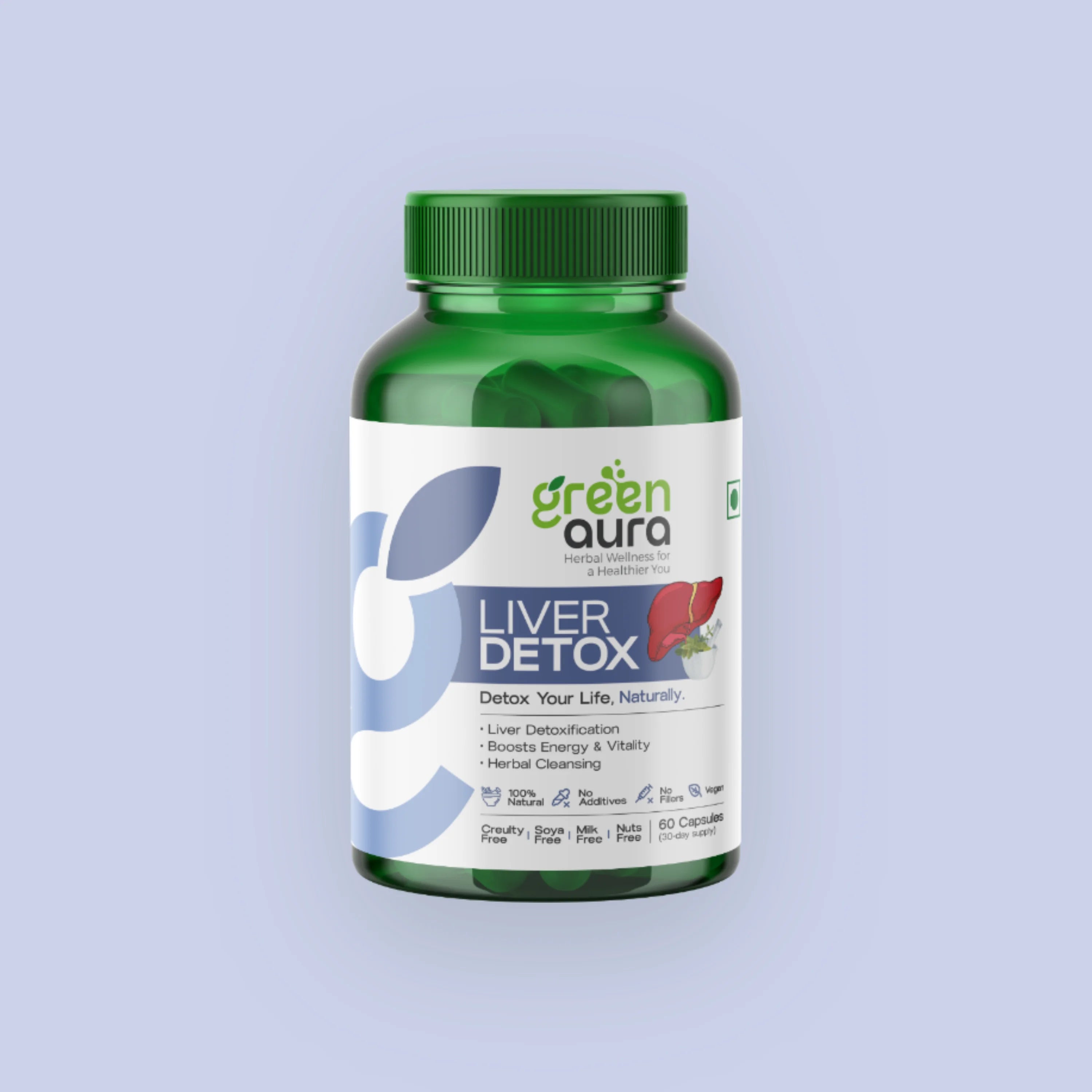
Ayurveda has traditionally used herbs such as Bhumi Amla (Phyllanthus amarus), Kutki (Picrorhiza kurroa), Kalmegh and Punarnava for liver care. Our Green Aura Liver Detox is a daily food supplement with Bhumi Amla, Kutki and five other traditional herbs, every dose printed on the label and no proprietary blend. The finished product has not been clinically trialled. It is meant for everyday liver care alongside food and movement, never instead of them.
Please read this before taking any liver herb, including ours.
Not sure which habits to change first? Our free 2-minute wellness quiz (Take the Test) gives you a simple starting point to discuss with your doctor.
From Green Aura
Herbal supplements with every milligram on the label
Something with protein and fibre and little sugar, such as moong dal chilla with curd, vegetable poha with peanuts, or eggs with one roti.
Yes, one modest serving with plenty of dal and sabzi. The problem is large servings with little protein or vegetables.
A teaspoon on your roti or dal is not the issue. Total fat and frying are. Measure your cooking oil and cut deep-fried snacks first.
Expect to give it several months of steady changes. In research, the clearest improvements came with 7 to 10% or more weight loss. Your doctor can repeat your scan and tests to check progress.
Yes. Waist size, blood sugar and cholesterol tell you more than the bathroom scale.
No. No supplement replaces diet, weight loss, movement and avoiding alcohol. Talk to your doctor before taking any herbal product, especially if your liver tests are abnormal.
Halve the sugar in your chai. Make sabzi half your plate. Eat dinner earlier and walk after it. Measure your waist today and again in a month. And ask your doctor once about your fibrosis risk, then let them guide the rest.
More from our blog: small ways to bring Ayurveda into daily life.
About the author
Aditya Patel is the founder of Green Aura, an Ayurvedic food supplement brand that makes its formulas in-house at its unit in Vijapur, Mahesana, Gujarat. He is not a doctor; this guide is based on the published research listed above. Questions? Write to info@mygreenaura.com.
This article is for general information only and is not medical advice. Green Aura products are food supplements and are not intended to diagnose, treat, cure or prevent any disease. Please consult your doctor before starting any supplement, especially if you are pregnant, nursing, on medication or have a medical condition.


