Cart
0
You may also like





It is 11:40 at night. The lights are off, the fan is on, and you are "just checking one thing" on your phone. Forty minutes of reels later, your eyes feel hot and gritty, as if someone has rubbed a little sand into them. You blink hard, rub them, and promise yourself tomorrow will be different.
Tomorrow you open the laptop at 9:30.
If this sounds familiar, you are not imagining it. Eye strain from mobile screens has a name: digital eye strain (or computer vision syndrome). The good news: most of it comes from a few habits you can change today, for free. The less good news: some of the most popular fixes, the ones sold to you hardest, have weak evidence behind them.
Here is what is going on, and what actually helps.
It rarely shows up as one clear symptom. Most people describe a mix of:
A 2025 survey of 112 university students in Hyderabad found headache was the most common complaint (75%), followed by burning or itching (50%) and watering eyes (49%). Every single student owned a smartphone. (Bhammarkar, International Journal of Research in Medical Sciences, 2025)
For most adults, the screen is not damaging the eyes. It is overworking them, in three specific ways.
When you concentrate on a screen, you blink far less. The American Academy of Ophthalmology notes that focusing on digital displays has been shown to cut the blink rate by a third to a half (AAO). Every blink spreads a fresh layer of tears over the eye. Fewer blinks, and the surface dries out. Add an air conditioner blowing at your face in an office, or a ceiling fan on full speed at home, and that dryness arrives much faster.
Inside each eye is a tiny ring of muscle (the ciliary muscle) that tightens to focus on things close to you. A phone is usually held much closer than a laptop, so this muscle stays clenched for as long as you scroll. That is why distance vision is briefly blurry when you finally look up: the muscle is slow to let go.
A bright screen in a dark room, tiny text, glare from the window behind you. None of these is dramatic alone, but over six or eight hours they stack up.
Notice what is not on this list: blue light. We will come back to that.
Start here before you spend a single rupee.
Every 20 minutes, look at something about 20 feet (6 metres) away for 20 seconds. Out of the window, at the far end of the office, at the neighbour's building. This lets the focusing muscle release and gets you blinking again.
This advice was repeated for years without much testing. In 2022, researchers at Aston University in the UK tested it in a small study: 29 people with eye strain used software that reminded them to follow the rule. After two weeks, dryness, sensitivity and discomfort dropped noticeably. The catch: when the reminders stopped, symptoms crept back to where they started (Association of Optometrists report on the study in Contact Lens and Anterior Eye). The rule works only if you actually do it, so set a repeating timer on your phone or laptop.
A few times an hour, close your eyes fully and slowly, as if falling asleep, then open. Do this five times. It spreads tears better than the half blinks we do while staring at a screen. At the end of the day, a warm (not hot) compress over closed eyes for a few minutes can feel soothing.
For a laptop or monitor, the AAO suggests about an arm's length (around 25 inches, roughly 60 cm). For a phone, increase the font size so you can hold it further away instead of bringing it closer to your face.
Point the AC vent or fan away from your eyes. In dry months, or in a heavily air conditioned office, many people find this one change makes a real difference.
The phone-in-bed-in-the-dark habit is the hardest on your eyes because it combines everything: no blinking, very close focus, and a bright screen in a dark room. If you do use it at night, turn the room light on and lower the screen brightness so it is not glowing much brighter than its surroundings. Better still, keep the phone outside arm's reach for the last 30 minutes before you sleep.
This one is skipped more than any other. A small uncorrected power, a slight difference between the two eyes, or an old pair of glasses can make every hour on a screen harder work. If you have not had an eye test in two years, book one. It costs less than most "eye care" products.
We know this is an unpopular position, because blue-cut lenses are sold everywhere. But in 2023, a Cochrane review (a large, independent evidence review) pooled 17 randomised trials and concluded that blue-light filtering lenses may make no difference to eye strain from computer use in the short term, compared with ordinary lenses (Singh et al., Cochrane Database of Systematic Reviews, 2023). The AAO has said much the same. If you already own a pair and like them, there is no harm in wearing them alongside breaks and blinking.
Plain lubricating drops (artificial tears) can help a dry, gritty eye, and the AAO suggests keeping them handy. But "redness relief" drops are a different thing, and drops with steroids should never be used without an eye doctor's advice. Ask the pharmacist which type you are buying, and if you need drops every day, that is your sign to see a doctor.
The Indian kitchen already has a lot going for your eyes. Amla is rich in vitamin C. Carrots, pumpkin, papaya and green leafy vegetables like palak and methi bring carotenoids.
Ayurveda has its own long tradition of eye care. Triphala (a blend of amla, haritaki and baheda) has been traditionally used in Ayurveda for eye wellness, and is one of its best known formulations. Saffron and fennel also appear in traditional preparations for the eyes. If you are new to Ayurveda, our guide to small ways to bring it into everyday life is a gentle place to start.
On the modern research side, the herb that has received the most attention for screen users is bilberry, a European cousin of the blueberry rich in pigments called anthocyanins. Two placebo controlled trials from Japan are worth knowing about:
These are small studies, done in Japan, on bilberry extract on its own. They are encouraging. They are not proof that any particular product, including ours, will do the same.
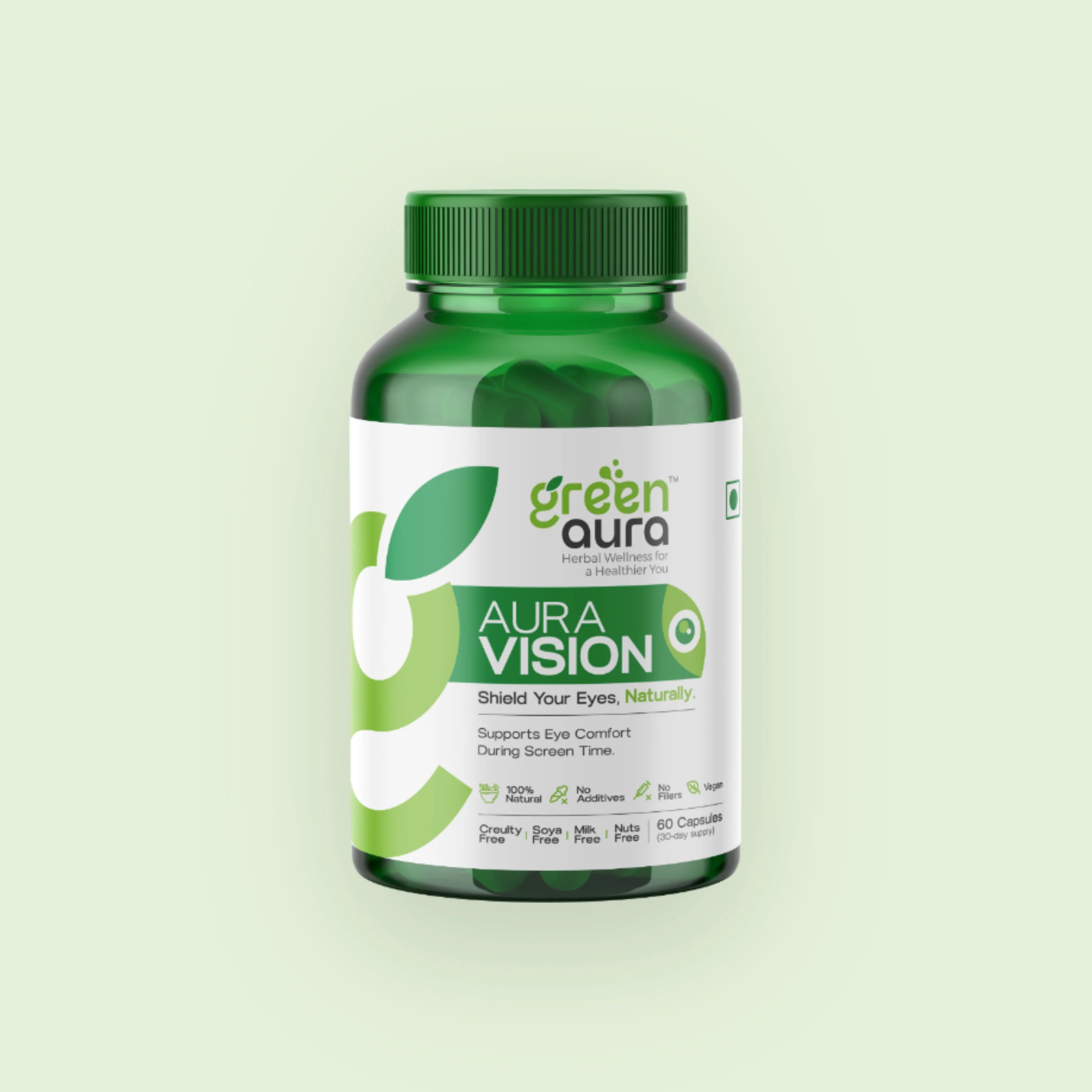
We make Aura Vision at our own unit in Vijapur, Gujarat, for people whose eyes work on screens all day. Each capsule combines Triphala (167 mg) and bilberry with 25% anthocyanins (83 mg), alongside goji berry, brahmi, fennel, marigold, saffron and deglycyrrhizinated licorice. The amount of every herb is printed on the label. There is no proprietary blend.
To be straight with you: at two capsules a day, you get 166 mg of bilberry extract. That is less than the amounts used in the trials above, and the product itself has not been through a clinical trial. We formulated it as a traditional Triphala base with bilberry and other herbs, to support eye comfort as part of good daily habits, not as a replacement for them.
If you are not sure whether a supplement fits your routine at all, or whether an eye check-up is the better first step, Take the Test, our free 2 minute check.
Please see an eye doctor promptly, rather than trying home care, if you notice:
Eye strain from your phone is common, and mostly a habits problem. Blink, look far away every 20 minutes with a reminder, push the screen back, turn the room light on, and get your eyes tested. Be sceptical of anything that promises to fix it while you keep scrolling in the dark. Good food and traditional herbs can be part of your routine, but they work best alongside the habits, never instead of them.
Tonight, try putting the phone down 30 minutes earlier. Your eyes will tell you the difference by morning.
For adults, current evidence says digital eye strain is uncomfortable but temporary. Symptoms usually ease with rest and better habits. Children need more care: eye doctors commonly advise limiting their screen time and making sure they get plenty of outdoor play, and a child with frequent eye complaints should have an eye test.
For many people it eases within hours of putting the screen down. If your eyes still feel strained after a screen-free day, or it keeps returning, get an eye check-up.
A 2023 Cochrane review of 17 trials found they may make no short-term difference to eye strain from computer use compared with regular lenses.
Har 20 minute mein 20 second ke liye door dekhiye. In short: follow the 20-20-20 rule with a timer, blink fully a few times every hour, increase the font size and hold the phone further away, turn the room light on at night, and keep the AC or fan away from your face. If the pain is sharp, the eye is red, or your vision changes, see an eye doctor.
Dark mode can feel more comfortable in a dark room, but there is no strong evidence that it reduces eye strain by itself. Matching screen brightness to the room matters more.
Save this guide for later


This article is for general information only and is not medical advice. Green Aura products are food supplements and are not intended to diagnose, treat, cure or prevent any disease. Please consult your doctor before starting any supplement, especially if you are pregnant, nursing, on medication or have a medical condition.


